Interview Tactics

Much like Yuliya, I also found it difficult to address the “So what?” Obviously it's an issue that I feel matters, and since then I have thought about clarifying certain aspects of my larger question.
I am trying to tie the subject of ethnographic approach to my own interview approach. I admit that I'm a fan of the interview method- as Luker points out, I believe that resurfacing patterns of opinion amongst a substantial number of individual interviewees lends a lot of credence to research and suggests broader social implications. I was initially considering conducting an epic mixed method approach, complete with hundreds of interviews and thousands of surveys. Wouldn't that have been awesome?
Interestingly enough, I'm conducting an interview today for another class I'm taking! My main concerns are 1) to make the interviewee as much at ease as possible 2) to ask appropriately open-ended questions, and 3) to document the findings as quickly as possible (as Luker urges us to do). I am also considering using Luker's reverse-psychology tactic of asking intentionally leading question in order to illicit clarification – although I would have to justify this method to the professor. Shaffir notes that the idea of removing political views of the researcher is a “facade.” As such, in my own interview I will attempt to remain as receptive as possible, and then follow-up with a reflexive approach.
-Martin

I'm an ethnographer and I didn't even know it!

Ethnography. I've gone from never really hearing the word before to it permeating my weekly readings and discussions. This word has popped up in all four of my classes, it must be important. I come from a humanities background, where personal research was not forgrounded or necessary to get one's degree (in my personal experience). Ethnography was a method reserved for those in anthropology or social sciences, those studying actual people...where as I felt I was just investigating the artifacts or output created by people. Now I see that this was kind of a silly distinction that I made up in my head. I saw studying belief and studying action as divorced from each other. However, as Luker points out, that when belief and action are combined we get 'pratices' and this is what good ethnography studies.

In December of 2006 I began on my own ethnographic study...without even knowing it. Like many fresh graduates from university, I was unsure what to do, so I moved to Asia. I situated myself in a small town named Hualien in Taiwan to be an English teacher. Admittedly, I was very much overwhelmed at first. Reading Luker's explanation of living in a different culture actually made me laugh out loud, because it was so true. Everything was a puzzle, I couldn't read, write, speak or listen. I never ended up getting a bank account, because it was too confusing. I had local friends, but I still lived completely on the periphery and was recognized as an outsider just by how I looked. Obviously, I was not aware that I was doing an ethnographic study so I didn't keep field notes, but I did keep a sketch book and a journal where I recorded my thoughts about my life there. After living there for almost a year, being 'let in' to the culture to a certain degree, I believe that I can say I know a very minute bit about the Taiwanese small-town practices. In retrospect I wish I would have paid closer attention instead of just being in awe. It would have been interesting to study more of the subtle practices, rather then just the big obvious ones. For instance, I was the only foreigner working at my school, it was unclear to me how authority worked there. I was told in a very round-about way if I was doing something incorrectly. Using ethnography to study power structures would have been really neat (and probably have helped me out, as I was confused most of the time).

Using ethnography to study library and information science seems like an odd fit at first glance. But if you look at both libraries and information as the products of practices or entities in which particular practices happen, ethnography seems like a logical method of study to use.

Playing digital games after writing a SSHRC proposal

A perspective on the SSHRC proposal: I am afraid that in my proposal I didn’t answer the question “So what?” for the reader. Things discussed in it seem so obvious and connected, flowing from each other: (i) computer games are fun, (ii) work usually lacks this property (not that people don’t like their jobs; simply tasks they may have to conduct at the computer are not always exciting, engaging or providing possibility for personal growth), (iii) games have specific mechanics that are considered to be reasons of fun, and fun at work that doesn’t exclude work itself is a benefit for employees and consequently for organizations, (iv) why not to apply those game mechanics to work and observe fruitful results of work becoming fun? It is simply saying and it is all their but I am not sure that these ideas in proposal are fully interconnected to justify a proposed research, mainly because I somehow focused more on games than on work: was it the right focus for two pages or not?.. Also I now intend to reexamine my methodology and add more studying of context, documents, history of the organization or department (considering where to put boundaries will be a tough job, I guess). It is all under the influence of INF1003 course materials on interpretational research; I only have to figure out how to apply it to small scale research without luxury of several years to conduct it.

From doubts and intentions to pleasant thoughts. I was intrigued to hear a discussion at the lecture about digital games (it isn’t hard to guess why, if you’ve seen a glimpse of my proposal above). I have to admit that I’ve never reviewed literature on game violence research and found it insightful to learn about biases and politics involved that are especially distinct in observation: if games can aid in learning and teach good things, why simultaneously they will be considered absolutely neutral in regard to teaching bad things. My new, general, and probably greatly biased thoughts on this account are as follows.

I am conscious of the nature of skepticism in that observation, but can remember only very-very few games that actually “teach” bad things, meaning encourage them. If violence is present in games but is punished or regarded as a disgusting act (what is mostly the case; even if you chose “bad” path in the game, you don’t get attractive results or tapping on the shoulder; if you find destruction and tears, and pure power attractive, isn’t it your nature? if the game gave you a choice, isn’t it your choice? but I digress...), than game can mostly teach things about punishment and violence’s disgusting nature. At the same time people put a great effort in designing good teaching tools, and research, and debate a lot on how to do it; so, if we consider that violent game teaches violence, we can, with every reason, reward its game designers with PhDs of psychology and education. ...And on the other hand we have “susceptible” child’s psyche (“bad” path is easier, I always follow it in games, let me try it in the real life) and factor of getting used to things (there are so much violence on the screen, I can easily stand one more case in the real life) that are themselves full of contradictions. On the grounds of my opinion (sounds even too academically :) ) I would suggest that maybe researchers don’t need to learn so diligently from each other — those who study games as violence promoters and those who study teaching tools in the form of games — but rather apply their research methods to see how games do as right-things promoters and games as a form of having fun, respectfully. In my view, these studies differ greatly and the term “teaching” has to be used cautiously, that is why in one of the cases I chose to use “promotion”.

Last-minute observations

My initial crisis with the SSHRC proposal was that I felt it covered too broad a topic. It also seemed to me that a large-scale, mixed method approach (while ideal in my opinion) would be completely unrealistic for small-scale research. To remedy the situation, I reduced the scope of my research to a relatively small, specialized population.
I felt that a semi-structured interview was the most “suitable” for the kind of qualitative research I was thinking of. However, as a result, I feel that I'm in a position where my potential findings could be interpreted as “lacking generalizability” or, as Luker puts it, “spurious!” For a long time I was questioning whether or not it would be a struggle to draw greater implications from the potential research results, but I think addressing significance and specifying questions helped to alleviate that fear.
For me, the theme of the Kline article seemed to be that research is interpreted differently depending on the audience, and can be rendered subjectively insubstantial through this process. It seemed quite relevant to the concerns I had about my SSHRC proposal, because my topic also deals with legal battles around media freedom!
-Martin

(Re)shaping the question

My primary area of interest – other than archival studies – is English literature, and in particular Shakespeare and the English Renaissance. When writing my research proposal, the greatest difficulty that I found was how to articulate my interests, which are literary (and therefore belong more to the ‘humanities’ school) in nature, within the framework of the social sciences. In particular, the methodology section was confusing, as I am used to thinking of ‘the method’ as simply reading a text, thinking about what the work says, researching the criticism that has been written about the work, and then attempting to contribute to the scholarly tradition with my own analysis. I thus found myself having to think of how the project, originally entirely theoretical, might have some practical applications which could be researched and established through a more ‘sociological’ approach.

Overall, however, I found the experience of writing a SSHRC proposal extremely rewarding. In particular, it helped me to refine my interests and general objective. I will try to use this approach again (if I am ever put again in the position), when I write literary criticism. By thinking of how my analysis can be applied to practical, real-world questions, I should be able to present my work in a more convincing shape.

Interpretive research

In reading (most) of the Kline article, I was reminded of my undergrad that I did in theatre and film studies. Audience research was often referenced, but I remember profs complaining that there was never enough audience research and it was never conclusive.
Then I was reminded of my research proposal that I had just completed. It is essentially a bastardized (can I say that?) version of an audience research study. I'm looking to see how internet usage affects the identities of 36 women, comparing digital natives with non-digital natives.

I know that internet usage is exponentially more interactive than passively taking in a film or tv show, but there is still individual meaning-making going on. My aim, to look at the diversity of reponses of two particular groups to one cultural artifact...the internet, is similar to that of audience analysis. And I'm using a survey, focus groups and interviews with participants to inform my research, which are all methods of audience analysis.
Some of the complaints against these methods are that they are overly 'interpretive', and...well...they are. But how else can you measure feelings and responses? Some things just aren't easily quantifiable, that's why the 'media effects' debate that Kline investigates is still raging, it's impossible to directly link personal meaning-making with generalized causal effects.

So how can I make my study seem more substantial than me just asking 36 women about their feelings? Luker comes to the rescue, as she often does, with the suggestion that we can choose a sample "in such a way that logically, if not statistically we can generalize to some larger population" (pg. 125). While my particular study will not yield results applicable to the world as a whole, it would not be unsubstantiated to say that it may be generalizable to technologically active women in Toronto, Canada, maybe even North America. There is no reason not to believe that the 36 women chosen at random from around Toronto are not typical of the rest of the country. This puts the onus on the critic to disprove that logic...which comforts me.

Visual Research

On last Friday, I had attended Visualization Workshop organised by Eleonore and Jennette which was based on Gauntlett’s visual sociology methods. We built clay models of our research idea and explore with each other. This exercise facilitates more abstract thinking and more direct communication. Our research work is to develop a system for clay modeling supporting ways of interaction that are easy, intuitive and pleasant. Clay modelling helps to express our response and exchange of verbal information. It was interesting to see different approaches used to specify the visual research. This led to attempts to clarify, reframe and explore the research.

Visual Research is a wide variety of technical and creative expertise.Visual Research features a powerful blend of talented people and the latest technology allowing us to bring a compelling visual style to each project while maintaining the highest levels of reliability and security.Visual Research has been researching Internet traffic virtually from the beginning. The tools available for analysis today are very advanced and can be customized to detail every movement.

Online Research Methods

My research idea prompts me to conduct a considerable amount of my research work via the internet. Therefore keeping with the various discussions going on regarding various methods I decided to write about this special but increasingly important and interesting form of researching.

Internet has facilitated and arguably stimulated a trend towards research by ‘ordinary’ citizens (though there remains the need of learning social research methodology); just like it has made possible expressing individual ideas, developing new software, creating a new culture and so on by the masses. Online research methods are gaining popularity by the day even for professional researchers and it surrounds the process of researching in, on, and through the internet. “One of the striking things about online research methods is their versatility and their range. Researchers from many disciplines, with varying methodological preferences, deploy a wide range of online research methods to an impressive variety of research problems” (Lee et.al.). However, a research design has to be constructed that would help in generating reliable and valid data. There are various kinds of Internet or online surveys like web surveys and email. Virtual ethnography concerns applying ethnographic approaches and sensibilities to the study of online environments looking especially into the economic, social and political contexts within which online activity takes place. Blogs, networking sites, online interviews and focus groups can all provide channels to looking into such multi-user virtual environments (MUVEs). The internet also happens to preserve and provide an access to a large amount of data being archived in data sources of a size and complexity impossible for any one researcher to assemble on their own. Digital traces left behind by our electronic interactions are just one of the ways in which data is being created and it is very much an ongoing process. The huge archival resources of information on the net are not fixed, time-bound, geographically limited; are contributed/distributed by multi-user; and valuable to researchers from a wide variety of disciplines and interests. There exists a large volume of software today for developing, conducting and analyzing the data in the semantic web, for mapping networks and examining network properties, for data warehousing and data mining and other technologies, techniques and procedures. Keeping in mind the ethical implications of technological change especially privacy and confidentiality the internet with its ever growing repository of information and data has emerged as having a singular potential for ongoing social research.

Adapted from “The Internet as a Research Medium” by Raymond M. Lee, Nigel Fielding, Grant Blank.

Confusing the Map for the Terrain

It was something abut Luker’s discussion of generalization that clicked for me this week. All this time, while I have been struggling with a scope/frame/focus, I’ve been neurotic about leaving an important aspect out of my research, studying things out of their context. To cover my bases, consequently, my research daisy had every discipline attached to it, my clay model included pretty much everyone in the world, and my research question kept branching out into a horribly complex question tree.

But I’ve realized something during these past two weeks about small-scale research: it was never meant to be a forum to test my theory directly. Rather, I have to study a manifestation of it, something concrete. 

In my case, I’ve been trying to construct a test to research the generalization that ‘the visual design of information is a powerful venue.’ I needed to approach this from the other end, however, and study a particular ‘case study’ that illustrates this generalization. With this basis, I can ‘logically’ generalize (as Luker reminds us is equal to the canonical’s ‘statistically’ generalization).

This might sound simple and obvious, to be honest, I’m not sure why its taken me this long to figure it out. I think I just got so caught up with making something ‘relevant’ I immediately went to these grand sweeping theories. While Luker discusses the importance of abstracting the study to make it relatable, I had to concretize my abstraction to make it study-able. It's a weird thing to get so caught up building a map that you forget about the terrain. I’m glad I found land again though, just in time for assignment 2 :)


The Importance of Limits

I am not doing a thesis. It feels sometimes like I'm the only one in class who isn't, because it seems that most people have great, well thought out, clear research projects, unlike me. I never realized how difficult it would be to come up with a research project completely on my own, which is what I'm having to do for this SSHRC proposal. Without a pre-planned project, this mock proposal is essentially an exercise in imagination: what I would do research on, if I had the desire to do a thesis. Because I have no foundation of already-done research or a plan for a future SSHRC proposal, it's been difficult to rein in my interests into one potential research project, seeing as I am not constrained by research guidelines or course material. At the beginning I thought it would be awesome, to do whatever research project I wanted. But when you have unlimited space to work in, it gets difficult to find that one small thing you want to focus on.
This process gets even more difficult as the research process begins, because (as I mentioned previously) I have a tendency to get of track with my research - whatever catches my eye, I have a need to follow, sometimes until the original topic of my project is almost forgotten. Without a clear idea of what I'm researching, or at least with an idea that's very malleable and up to my own discretion, any source I find that is only halfway related to my topic but nonethless seems interesting, I will follow. I guess this project will be, for me, an exercise in self-discipline, as I force myself to finally focus on one thing and follow one track to the end.

The Visualization Workshop

On Friday, a few students met in the Inforum to take part in a hands-on visualization workshop, based on Gauntlett's visual sociology methods. As many of you know, we built clay models of our research ideas in order to externalize our proposal and share it with other students for feedback.

The following agenda was used: introductions, icebreaker, research visualization and debrief. The icebreaker consisted of asking each participant to build her favorite animal our of clay. This stage was very interesting as each person created a unique model with a very personal story attached to it. The trust and comfort this created set the stage for the more complex research visualization stage.


Although there were no rules given to how literal or abstract the model had to be, it was interesting to see different approaches. Some people kept to quite literal figures (virtual library = a person with a computer), others resorted to conventional signs (money = dollar sign) while others kept to incoherent figures that could not be read without explanations (balls of clay representing people). Each student explained her research idea in detail, and the conceptualization was critically examined by the other students. This led to attempts to clarify, reframe and explore the research.


Clay proved to be an effective medium. While it was perhaps more intimidating than lego at first, requiring students to be more artistic than some of them might be used to, after the icebreaker students seemed much more at ease. It was commented at the end of the workshop that clay is much more flexible and tactile than lego, which lends itself to linear structures. All in all, we concluded that this method could be useful both in the practical setting (community workshops) and the academic setting (research).
Thank you to all who participated!

Ones proposals inspiring others

Reading examples of SSHRC proposals interestingly gave me good exposure to sociological research methods. In the course we are still only starting to explore vast variety of them and trying to apply interviews to the needs of my enquiry made me think that I can successfully use them but that they are not the main and far not the only tool I need. Also Luke almost convinced me to look for a “juicy case” where my semi-ethnographical research will bring to light exactly those elements and processes in the world I am curious about. Along with all that I felt that I need either experiments or prototyping, but without doubt something that can test a practical side of my research and developments that result out of a part of it. Several SSHRC proposals gave me an answer (I think so at this stage) in such a terms or phrases like “test-case” and “research will take place in the context of the development of a tool”. Their meaning for me resides in possibility to in a way create a case myself and study it, turning one of the research components into preparatory phase where I try to more deeply understand what needs are there and how my system will address them. And yes, system. I am very glad to finally see a way how I can pursue my chosen path of Information systems in this course without being too theoretical and exploring ways of designing them better.

One more thing to say about read SSHRC proposals: they turned to be very diverse, which freed me from worrying about number of citations, complexity of language, and size of the allotted place to different sections. The other thing is now outlined for me as more important and even advisably necessary, and simultaneously so simple and obvious: making an accessible and interesting story/statement about my research interest and demonstrating a question with a potential answer bringing a useful outcome.

Music SSHRC Proposal

Since I'm tearing my hair out trying to get this research proposal to make any sense, I figure for this weeks blog I will deconstruct the hardcopy SSHRC proposal example that I have and am currently using as the template for mine. Maybe it will help me to break it down further. And other people wrote about their proposal examples :)

I like this proposal because it is broken down into very clearly labelled subheadings: Program of Study Statement, Context, Objectives, Methodology and Contribution to the advancement of knowledge. A nice clear template that I can use for mine.

Program of Study Statement: This person is a fellow master's student with a passion for music. She/he wishes to use their own experience with music to inform their proposed research of how musical knowledge is being transmitted through the use of information communication technologies.
-it sounds like this person has a keen interest and know-how on the subject matter

Context: They then go on to write about where they came up with the idea, what relevant courses they've taken and a current collaboration with a specific professor in the field. Other research that discusses issues in the same realm but are different than the proposed research are also mentioned.
-I'm having a problem with this section as I have no names to drop, I feel like naming a professor you have already set up a working relationship with would give you more authenticity (brownie points). Since I'm not actually applying for a SSHRC, maybe I can make it up to sound more convincing?

Objectives: This is where the applicant discusses the focus of the research: where, what, who. What they want to understand from the research and the concepts that they are going to apply to their research. Also, they discuss what they are going to do with their findings.
-I have no concrete concepts of which to apply, in fact I'm a little foggy on what exactly that means. The concepts that this applicant mentions are not discusessed in any detail nor linked to any actual part of the research. This bodes well for me as I excel at being vague.

Methodology: Here is where the applicant informs us about the methods they will be using to conduct the research. This person prefers an ethnographic approach. They state how they are going to document the research both in real life and online. They state again who their testing group will be.
-this part was actually okay for me...I think. However I got confused in the proposal example when they cited a name after every method, do we actually know who made up the unstructured intereview?

Contribution to the advancement of knowledge: This section is exactly what it says it is.
-I'm having trouble with this section...

All in all I thought this proposal was interesting, but not super ground-breaking, which actually gave me hope for mine. I like that they mentioned Paco de Lucia in it.

SSHRC Proposal Example 4

This proposal is a submission from a master of psychology student, researching student-teacher relationships to understand how to deal with behavioural problems in the classroom. The overreaching theme seemed to be that everything they have done (volunteer work, past education, past research) and will do (continue with a dissertation) connects back to this research. To me, it was this dedication to the project that makes this proposal very convincing.

The proposal is divided into three main sections. 

1. Personal Qualification and Background Information; approximately half a page in length, this section spoke briefly of the root of their research interest and the various experiences that 'reinforced' their interest. Spoken in the past-tense, each experience also cited their role and the general benefit of each experience.

2. Relevant Course Work; at only a single paragraph, the smallest section, the author quickly describes their program and what courses they will be taking this year to help prepare for this research. A variety of course types was stressed (theory, practical, research) and connected back to how this will help conduct research.

3. Proposed Master’s Research; the bulk of the proposal, just over a page, the author subdivides this section into three main areas:

3A. Previous findings; as this research is an extension of previous work, there is a discussion of what has already been done (with citations of author and date) and the gaps in the research they wish to fill in.

3B. Methodology; a two paragraph overview of the approach of the research. Most of the sentences are action oriented (‘Participants will complete’, ‘I will use direct observation’, etc).

3C. Importance of research; as one of the closing paragraphs, this section reinstates the relevance of the research project and also mentions their intentions of furthering this research into a dissertation.   

Finally, a few sentences explicitly stating that her preparation makes them a strong SSHRC candidate close the proposal.

“Beat the Uncertainty”

Understanding the overlapping areas of the petals of the research daisy and pooling in all of them to the core seem to be one of the trickiest tasks, very much like introducing aliens into a Michelangelo conversation. Luker’s research process seems to be extremely exhilarating at times. To think of it as logic of discovery instead of logic of verification and theory generating and not just theory testing makes us reach a whole new level.

Whether it is gaining entrée into the information world and then deciding through data cropping what is relevant to the large picture: it seems daunting when the task has not even begun. Organizational research, which I am planning to partake, not only involves assessing the extent to which a program has achieved its intended results but also acute observation of the users and usability of software interfaces. Meta-analysis is also often regarded as the dominant approach for the organizational sciences. Ethnographic research is no doubt one of the most applicable to our changing times. Pertaining to the earlier described visual research methods, there are in reality various exotic ways of finding out that information which will lead us to the deep meaning, for example, there are processes like Sensory analysis which is a actually a branch of psychology. Personally I was once very interested in research through photography. But then, sometimes I feel the need to know the canonical ways too so that they can give me a more rigid structure. What is required, in short, is an awakening – visual or verbal, that would point me to the North Star.

Research Question

As Yuliya mentioned in her blog that ….lot of dots because lot of thoughts. I am fully agreed with her because Research itself means search again and find out in a systematically and scientific manner. As we got assignment on research proposal and everyone is in their research thoughts. Before starting with the Research Proposal, I found that Research process must be clear. As Luker define in chapter 4 that most challenging task of this kind of research is to transform the Research interest into a Research question. There are four features set off a true Research Question from a Research interest:
1) a true research process.
2) understanding the relationship.
3) permit’s a range of possible answers.
4) a good research question properly answered.

Once research question is frame, it easy to take out the research proposal.
As I learned from the Research class about the framing of the SSHRC proposal this Monday. Therefore, the most important part in the proposal grant writing is the way that you frame your project, to make it relevant to the current topics. Yet, we have to do our own research project under the guidance of Prof. Sara.

-Meenaxi

SSHRC Proposal Example

I and three others got assigned the SSHRC Proposal Example #2, which is a Masters proposal for a research project that examines “the programs and policies of a chapter of Big Sisters,” in relation to body image issues among young girls. I have broken down the structure of the proposal, which I offer here (briefly). The first two sentences of the first paragraph begin with the word “I.” The first describes the student’s future academic affiliation, and the second describes the student’s “keen interest.” The remainder of the paragraph is dedicated to justifying a “space” for the research the student intends on undertaking. The second paragraph is concerned entirely with the student’s academic credentials – i.e. the courses they intend to take. The “purpose of the research” is in bold, and the particular objectives are listed in bullet points. The student then introduces each of the following sections with a subtitle: Background (which is allotted three paragraphs), Methodology (which is again presented in lettered bullet points), Contribution to the Advancement of Knowledge, and Access and Experience. Background and Methodology take up the largest portion of the two page proposal (probably about a page altogether). An interesting question raised during group discussion was the placement of the last section, Access and Experience. It seemed awkwardly placed, and as though it perhaps should follow the second paragraph, where the student lists the courses relevant to the research, and the perceived benefits of her supervisor’s guidance. My guess is that the student believed that, while relevant – and thus necessary to include – the reader would nevertheless judge this section the least “important” and therefore it was placed at the end. Or alternatively, because the student resumes their discussion of him/herself in the first person, he/she wanted to leave the reader with a strong impression of her expertise and trustworthiness. There was, however, a typo in the last sentence; the student writes “I belief my good…” instead of “I believe my good…” making it impressive that this proposal was accepted. Perhaps this was not the final draft.

Thorns of focusing

First Knight as if pushed gently to reconsider what research, or rather results of research mean: not description of state of facts but explaining them to the best of one’s understanding. The Luker’s voice added inertia to the initial push: explore, seek knowledge, seek place within it, slither into it, explore again, and add knowledge by answering your very special question... At that moment I stopped thinking that I didn’t have time to do Luker’s exercises: too exciting and promising became vision of challenging myself with following the way of the thinking researcher...

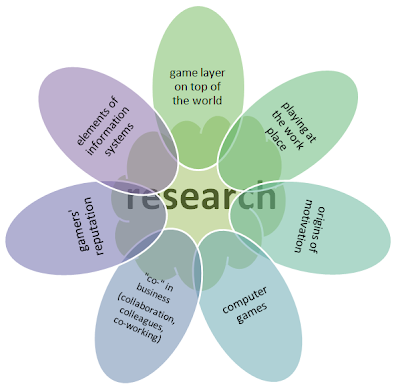
...A lot of dots because of a lot of thoughts... Especially the whole lot of them after the first rebound from the literature review while attempting to frame my research interest. Is the topic not worthy to be researched? No good skills of searching for what I need to find or even the lack of them in defining what I need to know? It made me to skip framing and proceed to the daisy:


My second literature review didn’t begin as focused as the first. I tried to stay calm about finding a little bit more on the petal themes than I expected to read in a lifetime except maybe the two of them. “Don’t panic” was the credo for this part of the work.

The victory over info glut flashed when I began to cross my broad searches in pares and was fully manifested for threes of them thanks to the great catalogue tools. Unfortunately, for me it doesn’t look satisfactory again for it seems as if I didn’t find those people who hold a conversation I want to slither in and I am not sure that I now have capacity to start a new one. I only can guess that the cure for this is still more focusing.

P.S.: for those who are not visual learners and researches as Jennette and Eleonore, but more of a textual, reading and “pronouncing in one’s head” types, I can advise for brainstorming such tools as Visuwords. Yes, it is pretty visual but the main point is in textual connections not imaginal ones.

One person's hermit crab is another's baseball cap

The play-doh community map (picture offered by Eleonore) instantly made me think about the board game ‘Cranium.’ In one of the categories a teammate constructs something with clay so that the other teammate can guess what it is. What is clear to one person is (very likely) confounding to the next. Granted, it’s within a short time limit, but it got me thinking about communication gaps and group contexts.
When someone feels they are under fire in a group interview, they will more than likely end up speaking the particular community language of the group, or what they think is proper in that setting. There can also be inequalities of representation between group members, in addition to miscommunications and misunderstandings. The Lunt and Livingston reading suggests that familiarity between members of the group can result in a more open group culture and therefore more substantive results.
Given the scope of our research, I may end up conducting one-on-one interviews regardless. At the cost of reliability and pertinence of the data (which will hopefully be covered in a separate quantitative data portion), I believe that in such interviews, people may give more complete and honest responses. This method could also sidestep the issues of arbitrarily mixing subjects into homogenous groups and then generalizing group opinions.

-Martin

Serious Play

Eleonore's post about the Lego Serious Play Research Project peaked my interest in the subject. I know it was a recommended reading, but there is A LOT of reading as everyone knows.

I grew up with an artist mother and went to art camp all through my youth, so I understand that some things are often easier to represent through art or visualization, especially when it comes to personal thoughts or feelings. It sounds like a "touchy, feely", super subjective method, and certainly not a quantifiable one, and it is. However, it's a method that may be able to tap into a person's psyche in a way that other methods don't have the power to. It's a method that allows for revisiting and revising as well. I like David Guantlett's personal work regarding the individual's identity, I think that I could use it to inform my own research choice.

For my research question, I'm playing with the idea of online and offline identities and how users feel about themselves in those different spheres. Are they different spheres? Or just extensions of one sphere? Do they require different identities? Why? I think that having a person build a representation for their identity in both their online and offline lives would be really interesting and revealing. Seeing the similarities and differences in the two representations would be very telling about a person's true feelings towards their contemporary identity (ies).

I was also thinking about having online and offline focus groups with the same sample and comparing the results...but perhaps that's for a different post.

Thank you Eleonore and Jennette for being so enthusiastic about such an interesting method, good luck on the workshop!