A perspective on the SSHRC proposal: I am afraid that in my proposal I didn’t answer the question “So what?” for the reader. Things discussed in it seem so obvious and connected, flowing from each other: (i) computer games are fun, (ii) work usually lacks this property (not that people don’t like their jobs; simply tasks they may have to conduct at the computer are not always exciting, engaging or providing possibility for personal growth), (iii) games have specific mechanics that are considered to be reasons of fun, and fun at work that doesn’t exclude work itself is a benefit for employees and consequently for organizations, (iv) why not to apply those game mechanics to work and observe fruitful results of work becoming fun? It is simply saying and it is all their but I am not sure that these ideas in proposal are fully interconnected to justify a proposed research, mainly because I somehow focused more on games than on work: was it the right focus for two pages or not?.. Also I now intend to reexamine my methodology and add more studying of context, documents, history of the organization or department (considering where to put boundaries will be a tough job, I guess). It is all under the influence of INF1003 course materials on interpretational research; I only have to figure out how to apply it to small scale research without luxury of several years to conduct it.
From doubts and intentions to pleasant thoughts. I was intrigued to hear a discussion at the lecture about digital games (it isn’t hard to guess why, if you’ve seen a glimpse of my proposal above). I have to admit that I’ve never reviewed literature on game violence research and found it insightful to learn about biases and politics involved that are especially distinct in observation: if games can aid in learning and teach good things, why simultaneously they will be considered absolutely neutral in regard to teaching bad things. My new, general, and probably greatly biased thoughts on this account are as follows.
I am conscious of the nature of skepticism in that observation, but can remember only very-very few games that actually “teach” bad things, meaning encourage them. If violence is present in games but is punished or regarded as a disgusting act (what is mostly the case; even if you chose “bad” path in the game, you don’t get attractive results or tapping on the shoulder; if you find destruction and tears, and pure power attractive, isn’t it your nature? if the game gave you a choice, isn’t it your choice? but I digress...), than game can mostly teach things about punishment and violence’s disgusting nature. At the same time people put a great effort in designing good teaching tools, and research, and debate a lot on how to do it; so, if we consider that violent game teaches violence, we can, with every reason, reward its game designers with PhDs of psychology and education. ...And on the other hand we have “susceptible” child’s psyche (“bad” path is easier, I always follow it in games, let me try it in the real life) and factor of getting used to things (there are so much violence on the screen, I can easily stand one more case in the real life) that are themselves full of contradictions. On the grounds of my opinion (sounds even too academically :) ) I would suggest that maybe researchers don’t need to learn so diligently from each other — those who study games as violence promoters and those who study teaching tools in the form of games — but rather apply their research methods to see how games do as right-things promoters and games as a form of having fun, respectfully. In my view, these studies differ greatly and the term “teaching” has to be used cautiously, that is why in one of the cases I chose to use “promotion”.
Showing posts with label Yuliya. Show all posts
Showing posts with label Yuliya. Show all posts
Ones proposals inspiring others
Reading examples of SSHRC proposals interestingly gave me good exposure to sociological research methods. In the course we are still only starting to explore vast variety of them and trying to apply interviews to the needs of my enquiry made me think that I can successfully use them but that they are not the main and far not the only tool I need. Also Luke almost convinced me to look for a “juicy case” where my semi-ethnographical research will bring to light exactly those elements and processes in the world I am curious about. Along with all that I felt that I need either experiments or prototyping, but without doubt something that can test a practical side of my research and developments that result out of a part of it. Several SSHRC proposals gave me an answer (I think so at this stage) in such a terms or phrases like “test-case” and “research will take place in the context of the development of a tool”. Their meaning for me resides in possibility to in a way create a case myself and study it, turning one of the research components into preparatory phase where I try to more deeply understand what needs are there and how my system will address them. And yes, system. I am very glad to finally see a way how I can pursue my chosen path of Information systems in this course without being too theoretical and exploring ways of designing them better.
One more thing to say about read SSHRC proposals: they turned to be very diverse, which freed me from worrying about number of citations, complexity of language, and size of the allotted place to different sections. The other thing is now outlined for me as more important and even advisably necessary, and simultaneously so simple and obvious: making an accessible and interesting story/statement about my research interest and demonstrating a question with a potential answer bringing a useful outcome.
One more thing to say about read SSHRC proposals: they turned to be very diverse, which freed me from worrying about number of citations, complexity of language, and size of the allotted place to different sections. The other thing is now outlined for me as more important and even advisably necessary, and simultaneously so simple and obvious: making an accessible and interesting story/statement about my research interest and demonstrating a question with a potential answer bringing a useful outcome.
Thorns of focusing
First Knight as if pushed gently to reconsider what research, or rather results of research mean: not description of state of facts but explaining them to the best of one’s understanding. The Luker’s voice added inertia to the initial push: explore, seek knowledge, seek place within it, slither into it, explore again, and add knowledge by answering your very special question... At that moment I stopped thinking that I didn’t have time to do Luker’s exercises: too exciting and promising became vision of challenging myself with following the way of the thinking researcher...
...A lot of dots because of a lot of thoughts... Especially the whole lot of them after the first rebound from the literature review while attempting to frame my research interest. Is the topic not worthy to be researched? No good skills of searching for what I need to find or even the lack of them in defining what I need to know? It made me to skip framing and proceed to the daisy:
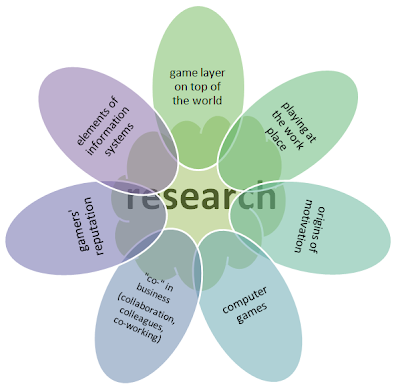
My second literature review didn’t begin as focused as the first. I tried to stay calm about finding a little bit more on the petal themes than I expected to read in a lifetime except maybe the two of them. “Don’t panic” was the credo for this part of the work.
The victory over info glut flashed when I began to cross my broad searches in pares and was fully manifested for threes of them thanks to the great catalogue tools. Unfortunately, for me it doesn’t look satisfactory again for it seems as if I didn’t find those people who hold a conversation I want to slither in and I am not sure that I now have capacity to start a new one. I only can guess that the cure for this is still more focusing.
P.S.: for those who are not visual learners and researches as Jennette and Eleonore, but more of a textual, reading and “pronouncing in one’s head” types, I can advise for brainstorming such tools as Visuwords. Yes, it is pretty visual but the main point is in textual connections not imaginal ones.
New but very hopeful to find social truth
Coming from engineering and chemistry, I’m very new to social research. Not only had I put extra efforts to bear with Luker and professor Grimes while exploring paradigms and deeds of human leaders in sociology, but also tried to enter a new state of mind, where promises like “you will not be trying to assess the distribution of individuals … across a known number of categories whose boundaries are clear” will not throw me into confusion. A chemical experiment without boundaries is more of a hobby than science (I was taught). Not that I’m saying this kind of hobby or passion didn’t bring humanity discoveries like penicillin, but still constant curiosity and attentiveness are not the same as conscious inquiry. Fortunately, the happy thing is that I’m becoming interested in researching our “fishiness” and at the same time more and more impatient about how to find categories that you didn’t set to look for; collect not too many and not too little data without aiming for exact data; acquire wisdom to be human (“fish”), but analyze findings without “public” constrains (being “fish”), and be sure that you add to universal knowledge, not only to personal hours worked.
What I want to find after learning this Salsa Dancing methodology is truth. And I believe it won’t deprive people of possibilities to find another truth, and yet another one, because, for me, truth is not complete and absolute in itself but what can help, guide or add to knowledge at the moment it was brought into light.
Every result or claim can be useful even if proved wrong, for then you can study why at the time of its research it was impossible to conclude otherwise. Of course, the researchers have to be good and open-minded students of methods (good: you can’t acquire basic knowledge from mere air; open-minded: roughly speaking, any grand theory can be disproved any time and better to be prepared to do it than not), and have to be the best in every contemporary to them aspect. Then there won’t be any doubt that research, including thinking, could have been done better — not in scale, but in attitude. So, any discovery made by such researchers will become a new brick for what we call research — a building knowledge process spread across years and centuries. All bricks, errors or not, compose research, and our view, and our understanding of the world; all bricks are valuable and truthful when brought to the construction site of knowledge with all possible precautions taken not to consciously or unconsciously deceive.
Writing for “n” minutes
Several times I’ve heard about 15 minutes-a-day-dissertations or books, and again I hear about the magic of “piecemeal” writing from Knight and Luker. But it is so hard to believe them! Sometimes I try to help skeptical myself by applying a larger scale. 15 minutes a day turn to be 91.25 hours per year or rather reasonable 3 hours per day for one month. Isn’t that enough for a book or at least a half? Maybe…
Only for me to have 15 minutes of actual writing means always adding to those 15 more minutes of prior preparation. After that I can even last for 30 minutes of writing or an hour - I won’t follow the clock. It can be alright, but does it mean I am doomed with mediocre and not very large works? I want to believe no; and at the same time I can’t stop wondering whether I miss valuable training and getting my hand in writing by committing preparatory thorough thinking for several days and then at last writing for a lot more than 15 minutes in a row. And I am speaking not only about book writing but also about composing any valuable record. Being able to remember things for more than a day I build thought over thought without going astray and without help from a paper or file. By the way, in their roots, days are artificial time divisions, so maybe they don’t determine that golden frequency for everyone. I want to believe again that you can find your way and that the main idea is never to dismiss taking notes, never leave writing till “someday in the future” when you already have thoughts or material for a paragraph, and as someone roughly said:
The worst thing ever written is always better than the thing never written at all.
P.S.: All the same, after words of persuasion I can’t get rid of a little bit of envy for such people as Balzac who acquire their best thoughts from writing or for authors whose characters surprisingly act as if by themselves on paper. Is it still another way or a better one?
The very last thought, I promise, that occurred to me: there is a use for 15 minutes rule. When you don’t have a theme, a work, or research, you better come up with something for a fraction of a day and write simply to stay in shape, to prevent blocks and to use this beautiful phrase you so treasured to come up finally with another and a new one. It seems that this is also the author’s idea.
A step into…
From the first days and classes, stepping into iSchool student’s shoes is extremely exciting! Moreover, being rather modest and communicating only a little with fellow students, I find this blog to be a gift-like opportunity to learn from, and listen to, and share with fascinating people. So, hello and thank you everybody involved!
Out of my Belorussian education in design of radio-electronic devices, a year of professional experience, and research conducted at the junction of engineering and chemistry, I raised and brought with me a wish to make working in any setting an organized, collaborative, and fun activity. Following my previous path, I enjoyed challenges of making things orderly and effectively or finding user centered solutions rather than doing exactly chemistry; and as the result, I came here to start walking along a new path of the humane systems designer.
Although I don’t intend to write a thesis, choosing this course was a fast and easy decision: I would like to have a steady and extensive knowledge foundation, and I can’t imagine acquiring it without knowing which instruments scholars use to develop a core of information science, and also without a skill to fully evaluate resources that will build now my own understanding and expertise through two years of studies. Adding to that, is enthusiasm to form in my mind an actual general structure and branching of information science, not that casual seemingly informed view of an everyday web, computer or library user. And I hope that methodological perspective will help me in this too.
Subscribe to:
Posts (Atom)